
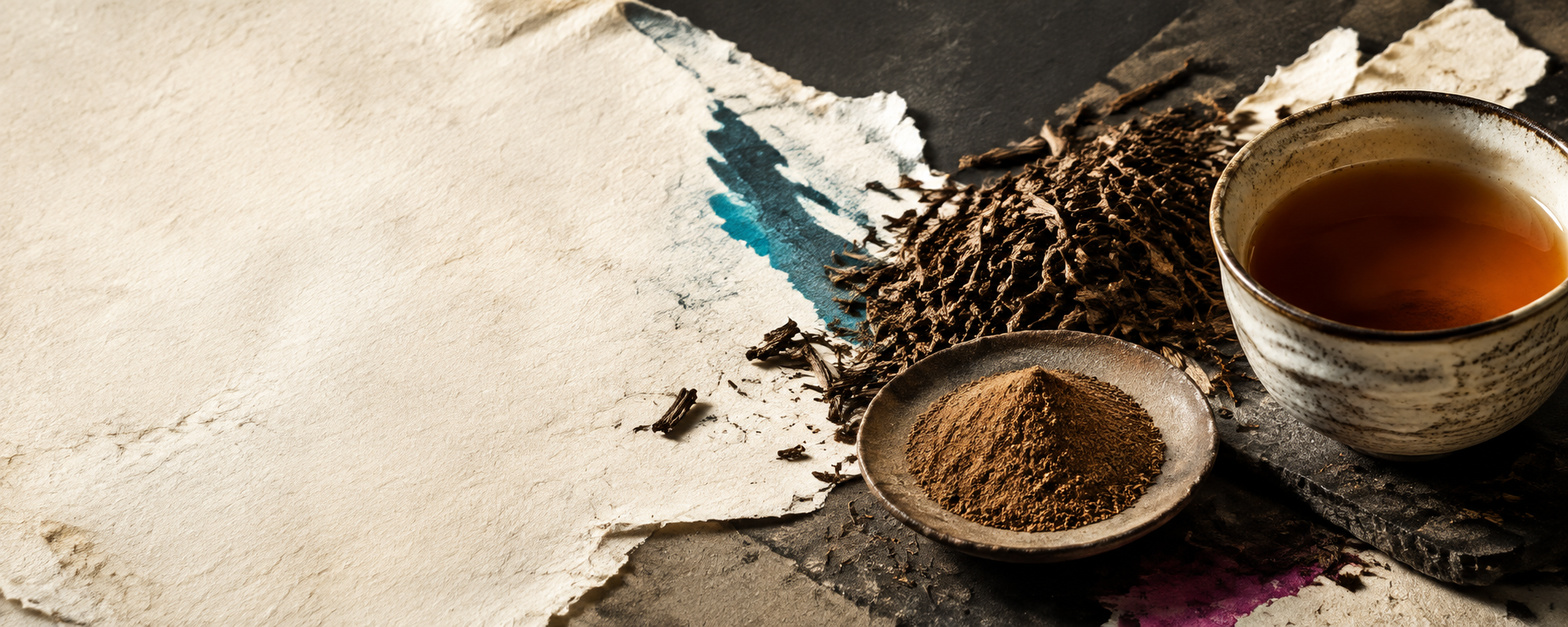
Once regarded primarily as an everyday Japanese tea, Hojicha is emerging as a versatile global flavour platform. Roasting transforms green tea into a softer, less astringent profile layered with toasted grain, caramel, nut, cocoa and subtle smoky notes—making it naturally compatible with café beverages, dairy, frozen desserts, bakery and premium confectionery. This interactive report tracks Hojicha’s progression from traditional roasted leaf to contemporary product innovation, highlighting the launches, sensory chemistry, applications and pairings driving its momentum.

 FlavourTrends.com
Interactive flavour pulse · 1920s—2026
Hojicha
The roast rewrites green tea—turning it into a modern flavour system for café, frozen dairy, patisserie and premium pantry.
The signal in four numbers
Hojicha’s advantage is not novelty alone. It translates tea into familiar roasted cues—toast, caramel, nut and cocoa—while retaining a distinct Japanese identity.
Japanese consumers reporting Hojicha use.
Cross Marketing · n=1,100 ↗the reported matcha incidence in the same survey.
36.9% vs 9.4% ↗the best roast in a 160/180/200°C GC–MS trial.
Applied Sciences · 2021 ↗key pyrazines quantified behind roast aroma.
Peer-reviewed aroma study ↗Why it is moving now
Specialist retail, national café launches and chef-led applications are arriving at the same time.
Three Hojicha + white-peach drinks at Starbucks Tea & Café.
Sep 2025 ↗Lawson MACHI café+ launches Hojicha–kinako smoothie.
Apr 2025 ↗Cuzen machines sold before its Hojicha system extension.
Sep 2025 ↗France, Germany, Netherlands and Spain added in 2023.
Hojicha Co. ↗“Toasted Walnut, Caramel, Cocoa.”
Blue Bottle · Craft Hojicha ↗
“Two expressions of the same leaf, separated by process and defined by contrast.”
Blue Bottle · Hojicha & Matcha set ↗
From roasted leaf to flavour platform
Select a stage. The image, commercial proof and linked launch evidence update together.
Select one of five stages
 01
01
1920s–2016
Roots — the roast is the product
Roasting mature leaves and stems creates a brown, aromatic tea with less green astringency and a naturally café-compatible profile.
- Kyoto is closely associated with Hojicha’s emergence; exact origin stories vary. Origin context ↗
- Hojicha Co. is established in 2016 as a specialist export proposition. Brand history ↗
Design the aroma—not just the colour
Drag the temperature control to see how the reported aroma balance shifts across the study’s 160–200°C roast window.
roast intensity
Balanced roast. Floral lift is best retained while pyrazines establish toast and nut character.
Alkylpyrazines
Roast · nut · cocoa
Increase with roast ↗Linalool
Floral lift
Peaked at 160°C ↗2-acetylpyrazine
Toast · popcorn · nut
Key roast volatile ↗β-damascenone
Fruity · floral depth
Falls under harder roast ↗Where the flavour travels next
Choose a format. The visual, pairing logic and proof point update immediately.
Choose an application format

Fastest route to scale
Hojicha × fruit foam
Milk softens the roast while fruit creates colour, acidity and social-media contrast. Strawberry and peach make the profile instantly legible without turning it into matcha.
Commercial proof: Starbucks Japan’s three-product white-peach/Hojicha collection launched across all 21 Tea & Café stores. View launch ↗
Build a Hojicha concept
Choose one format, flavour accent and texture. The concept name, image, rationale and formulation watch-out update together.

Café concept
White Peach Hojicha Latte
Finished with cold foam
White peach lifts the roasted tea with juicy aroma and gentle acidity; milk rounds the roast while cold foam creates visual contrast.
Watch-out: Keep the peach aromatic rather than candy-like so Hojicha remains the lead flavour.
Closest proof point: Starbucks Japan white-peach/Hojicha collection ↗