
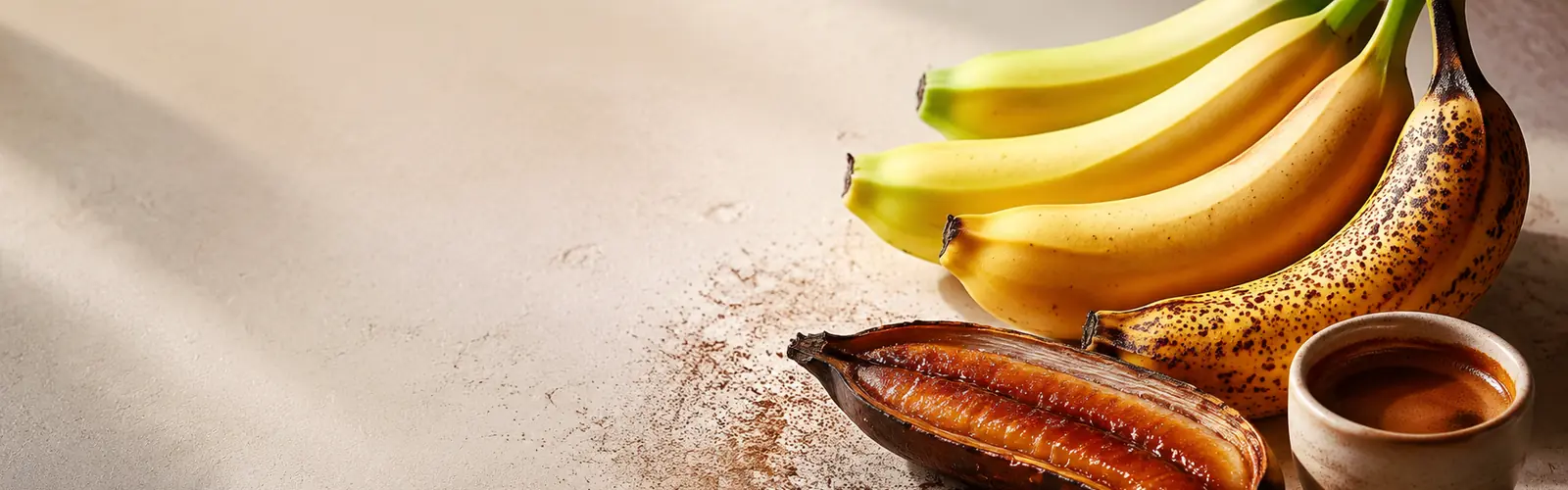
Banana is moving beyond its familiar roles in smoothies, confectionery and traditional bakery into a more sophisticated roasted-café flavour platform. Ripeness supplies creamy fruit, tropical esters and nostalgic recognition; heat introduces caramelized pulp, toasted cereal and darker bakery notes; coffee, matcha, chai and protein systems give that transformation an entirely new commercial context. The opportunity is therefore not simply “more banana,” but a carefully constructed progression from ripe fruit to roast, body and finish.
Designed as equal parts scientific deep dive, artistic experience and interactive playground, this report lets readers manipulate the flavour rather than merely read about it. They can move banana through five ripeness stages, compare cultivars, explore its volatile-aroma ensemble, test six heating processes, formulate café drinks, build pairing chords, redraw the sensory profile and generate more than 1,000 product directions. The result reveals both why roasted banana is accelerating—and how to keep it creamy, contemporary and convincingly natural rather than candy-like.
Compatibility mode · no dead controls
The viewer blocked the live laboratory.
The scientific content remains usable below. Expand these native panels, or open the file in a full browser to activate swiping, sliders, animated processing and the concept generator.
Ripeness architecture
Green fruit is aldehydic, leafy and starch-led. Clear yellow fruit balances fresh lift with growing ester impact. Brown-freckled fruit delivers peak dessert character. Black-spotted fruit adds baking depth but carries more oxidation and consistency risk.
Fresh versus roasted banana
Ripening builds recognisable banana esters; heating is a separate transformation. Roasting sacrifices some volatile fruit lift while adding concentrated pulp, caramel, toast and a stronger bridge to coffee. Brûlée protects more fresh fruit beneath a highly browned surface.
Café formulation routes
Espresso needs cream, cereal or praline between bitter roast and ripe fruit. Matcha benefits from rice or coconut body. Chai requires restrained spice so banana remains identifiable. Protein systems need oxidation, colour, chalkiness and separation validation.
Best application directions
Strong routes include roasted banana cold brew, banana rice-cream matcha, toasted banana chai, banana cereal protein, roasted banana gelato, dark banana bakery and banana praline confectionery.

Musa spp. · ripeness × heat × café
Bananaafter fire
The fruit is familiar. The new job is not. Drag banana from green aldehydes to ripe esters, push it through heat, then rebuild it for espresso, matcha, chai and protein.
01 · Commercial signal
The fruit was never new. The format is.
Banana has escaped smoothie logic. Search behaviour, independent cafés, chains and packaged beverages are converging on a darker, creamier, bakery-coded expression.
Yelp · Jun 24–Jun 25
6,267%growth in searches for “banana bread latte”.
Evidence ↗Restaurant beverages
#1Banana syrup was Circana’s fastest-growing ingredient flavour over the past year.
Evidence ↗Top chains · 12 months
100banana items from July 2025 to July 2026—already a record full-year pace.
Evidence ↗Café proof
30%share of sales reported for one viral Bay Area banana latte after starting near 10%.
Context ↗Proof begins at the counter
Café experimentation
Banana gains permission through familiar beverage rituals. Espresso bitterness and milk body stop the fruit from reading like candy.
02 · Ripeness engine
Before heat, ethylene rewrites the fruit.
Ripening is a biochemical transition: green aldehydes recede, starch converts, and ester formation surges. Drag the stage to see why “banana” is never a single flavour state.

Developer read: specify ripeness stage, not merely banana purée. The same cultivar can move from leafy and starchy to ester-rich, jammy and oxidized.
03 · Cultivar switchboard
“Banana” hides a library of architectures.
Cavendish familiarity is only one route. Dessert bananas and cooking bananas differ in ester load, starch, texture and thermal behaviour—so the cultivar choice should follow the format.
The universal reference
Cavendish
The most legible global banana cue: creamy, softly tropical and easy to place into milk systems. Its familiarity helps a complex coffee architecture feel accessible.
04 · Aroma ensemble
One ester is not a banana.
Isoamyl acetate is instantly legible—but a realistic ripe banana is an ensemble. Tap the orbit to see how green, tropical, citrus and warm-spice notes keep the profile from collapsing into confectionery.
ensemble
Impact ester
Isoamyl acetate
The fast recognition cue: fruity, banana-like and pear-adjacent. Essential in many profiles, but excessive dominance creates the “banana candy” shortcut.
R&D move: pair the impact ester with cream/cereal/vanilla body, restrained green lift and roast architecture. Recognition should be immediate; the finish should be adult.
05 · The brown shift
Ripening creates banana. Heat gives it a second identity.
Heating can strip fragile esters while water loss, sugar degradation and Maillard/Strecker chemistry build caramel, toast and baked depth. Switch the process to see the trade—not just the colour.

Fresh ripe banana
Fullest top-note fidelity. Fruit esters and fresh pulp lead; caramel, cereal and surface toast are minimal.
These bars are a formulation model—not measured kinetics. The documented anchor is that low-temperature drying caused compound-dependent depletion, including 25–87% losses among measured esters.
06 · Café bridge
Build the drink, not the syrup.
Coffee, matcha, chai and protein each need a different banana. Choose the platform and tune three tensions; the live brief will tell you where the concept lands—and where it can fail.

Espresso route · balanced
Roasted Banana Bread Latte
A ripe but controlled banana core, medium-dark roast bridge and oat/cream body. Nutmeg and praline extend the browned finish without erasing fruit.
07 · Application theatre
Seven formats. Seven different jobs.
Tap the application to see the most credible banana architecture, the commercial opportunity and the failure mode that must be designed out.
High momentum · high legibility
Roasted Banana Cold Brew
Use a darker banana fraction or roasted cue below a clean ripe top note. Cold brew tolerates cream, but needs aromatic lift to prevent a heavy finish.
08 · Roast chord
Choose three notes. Watch the centre change.
Banana is the core, not the whole composition. Select up to three companions to build a recognisable, differentiated chord; clear it to start again.
Selected: 0 of 3
roasted core
Open roasted banana
Add one note for direction, two for architecture, three for a complete concept.
09 · Sensory comparator
Fresh, roasted and café are not synonyms.
Switch among three profiles, then move any axis to create a custom target. The radar redraws immediately on desktop and touch screens.
Fresh ripe banana
Ester-led and creamy with moderate green lift, almost no toast and a clean fruit finish.
10 · Concept foundry
1,050 directions. One development brief.
Choose the format, brown note, texture and finish—or let the foundry shuffle them. The result is copyable and built around the same guardrail: familiarity needs architecture.
Roasted Banana Cold Brew
Layer a controlled ripe-banana top note over roasted banana and cold-brew bitterness, then use silky cream for length and sea salt to sharpen the finish.