

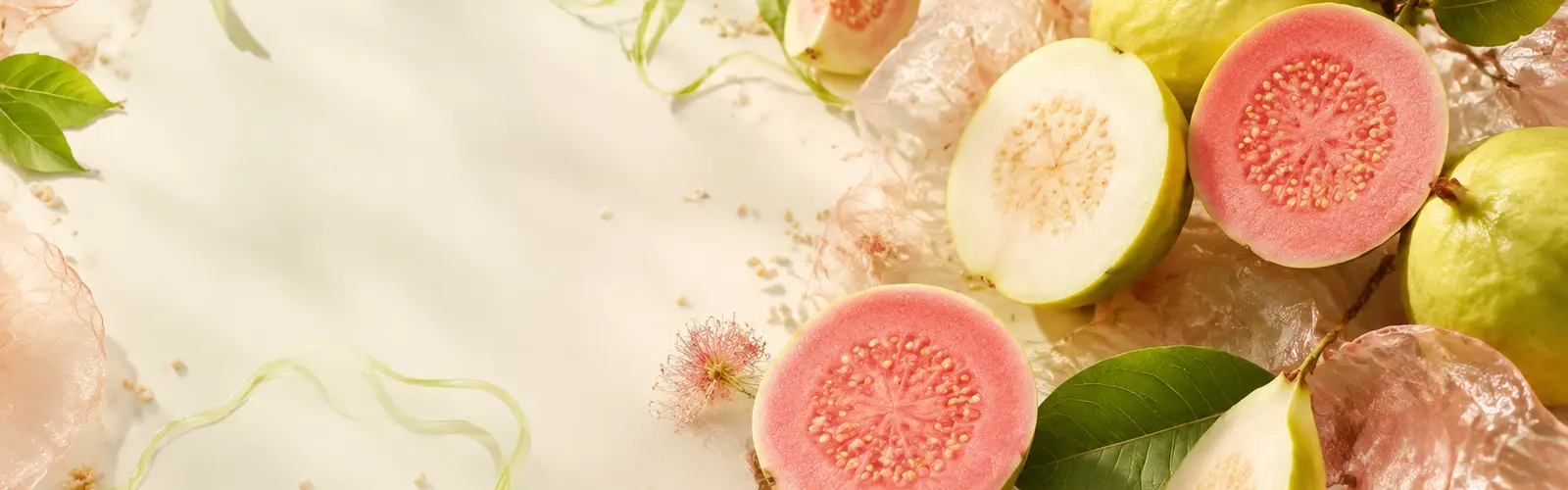
Guava is frequently reduced to a generic sweet-pink tropical flavour, yet the real fruit is far more intricate. Its sensory identity moves between freshly cut leaves, grapefruit-like sulfur lift, pear and strawberry nuances, floral warmth, juicy esters and caramel-like sweetness. Cultivar, ripeness and processing can dramatically alter that balance, while flesh colour alone cannot reliably predict the final organoleptic profile. Understanding guava therefore means looking beyond “pink versus white” and examining the complete system—from peel and pulp to volatile chemistry and finished application.
This interactive experience transforms that science into a playful piece of digital flavour art. Visitors can move the fruit through ripeness, compare pink- and white-fleshed guavas, dissect its edible anatomy, explore key aroma-active compounds, test processing routes, construct pairing constellations and generate original product concepts. Part sensomics laboratory, part creative studio and part interactive gallery, the page makes guava’s hidden complexity visible, tactile and genuinely fun to explore.

Psidium guajava • a ripeness-controlled aroma system
GUAVAThe green edge inside the pink
Guava is not one fixed “tropical” note. It is a moving balance of green C6 aldehydes, sulfurous tropical lift, fruit esters, floral warmth and caramel-like furanones—reshaped by genotype, maturity, cutting and processing.
01 • Market pulse
Familiar enough to scale. Strange enough to signal.
Guava sits in a commercially useful middle: consumers recognize the name, but its green–tropical aroma still feels more distinctive than strawberry, mango or generic “tropical.” The evidence is strongest in beverages, with room to migrate into dairy, frozen, confectionery and savoury systems.
U.S. menu acceleration
184%Growth in new U.S. menu items across four years, according to Datassential data cited by Wixon in 2025.
Recognition / trial gap
76/48Familiarity versus having tried guava. That 28-point gap is an invitation to make the first taste legible.
Search momentum
+27%Year-on-year growth in U.S. guava searches; McCormick reported +30% in Canada.
Blend behaviour
TOP 3Guava–passion fruit and guava–orange followed ginger–lemon among leading beverage blend signals in Innova’s 2025 analysis.
Click the evidence path
Recognition
Known name, unfinished experience.
Familiarity is already broad, but reported trial remains materially lower. The commercial job is not basic education; it is converting a name and colour expectation into a memorable first sensory experience.
02 • Cultivar decoder
Pink versus white is visible. Genotype is decisive.
Flesh colour is a useful design cue, not a guaranteed flavour specification. Research across 27 genotypes found enormous volatile variation within and across colour groups. Pink can suggest soft, sweet and floral; white can signal crisp, green and firm—but maturity and genotype can overturn the shorthand.
 PINK-FLESHEDWHITE-FLESHED
Pink is a design promise—not a guarantee.
Ripe pink guava often communicates softer tropical fruit, floral warmth and greater visual sweetness. Use it when colour and indulgence matter, but specify the actual cultivar, harvest maturity and volatile profile.
03 • Ripeness waveform
Slide from cut grass to tropical glow.
Ripening does not simply make guava “stronger.” C6 aldehydes and sulfur compounds trend down while esters and furanones rise. Green character remains important throughout, and cutting can rapidly create a fresh burst of (Z)-3-hexenal that intact fruit barely holds.
04 • Edible anatomy
Peel, pulp and seed core do different work.
The whole fruit is edible, but the layers are not interchangeable in formulation. Click the cutaway to isolate their practical roles, then decide whether the product needs a clean juice impression, whole-fruit authenticity or paste-like body.
Green / terpene interface
Peel gives the fruit its edge.
Whole-fruit systems can carry more green, bitter and terpene character than clarified juice impressions. That edge makes guava recognizable, but it can turn pithy if concentrated without enough fruit body.
05 • Sensomics constellation
Eight odorants hold the fresh-fruit illusion together.
A 2009 aroma-recombination study quantified 17 aroma-active volatiles, rebuilt fresh guava with 13, then used omission testing to expose eight compounds with decisive sensory roles. Click the constellation—the point is the system, not one “character-impact” molecule.
GUAVA
Omission-test key
(Z)-3-Hexenal
This C6 aldehyde is the blade of green freshness inside guava’s tropical body. It keeps ripe fruit from reading as undifferentiated candy and surges when cells are crushed.
06 • Processing survival lab
Preserve the top note—or rebuild it deliberately.
Heat at 95°C for five minutes reduced most measured guava flavour components in a juice study. Purée, HPP, pasteurization, concentration and paste-making each shift the balance between freshness, portability, body and cooked-note risk.
CUT
07 • Application theatre
One fruit, six commercial personalities.
The best format depends on which part of guava you want to amplify: carbonated lift, creamy fruit, pink visual drama, cooked paste depth or a green–spicy edge. Switch applications to see the design brief change.

Carbonation turns green lift into refreshment.
A bright sparkling base releases volatile green, grapefruit-like and fruity notes efficiently. Keep soluble solids low enough for lift, but not so low that acidity and peel cues become thin.
08 • Pairing loom
Weave a three-note chord around the guava core.
Select up to three partners. The loom maps each note back to guava’s fruit, green, floral, sulfur, sweet or savoury architecture and explains whether the chord clarifies the fruit—or disguises it.
Choose up to three
CORE
09 • Concept studio
Generate 1,050 guava briefs—without losing the fruit.
Combine a format, bridge note, texture and finish. Each selection rewrites the concept and formulation logic. The generator favours a recognizable guava architecture over random novelty.
Generated concept • 1 of 1,050
Passion–Guava Sparkling Veil
A finely carbonated pink-guava refresher with passion-fruit bridge, a transparent juicy body and sea-salt finish. Protect the green–grapefruit top note, keep sweetness below the point of nectar heaviness and use the salt to lengthen fruit rather than mute acidity.
10 • Sensory flight
Compare the fruit—then edit the sample.
Load a starting profile for ripe pink guava, ripe white guava or a sparkling application. Then move any axis. The radar and interpretation update live, making the sensory model a working briefing tool rather than a static chart.

