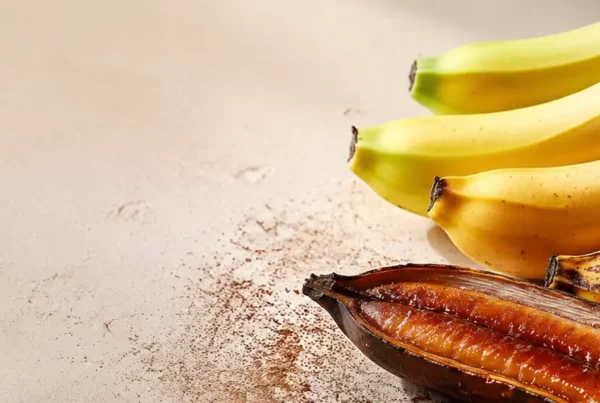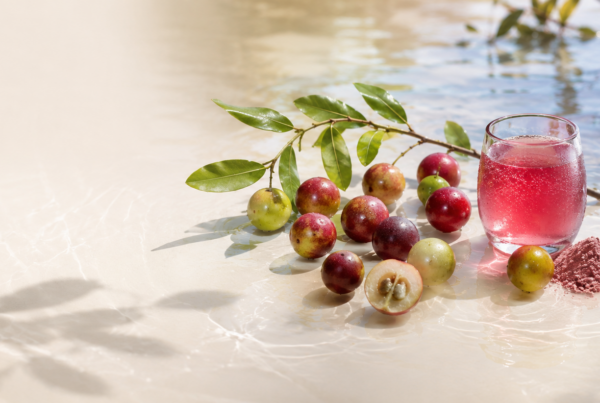

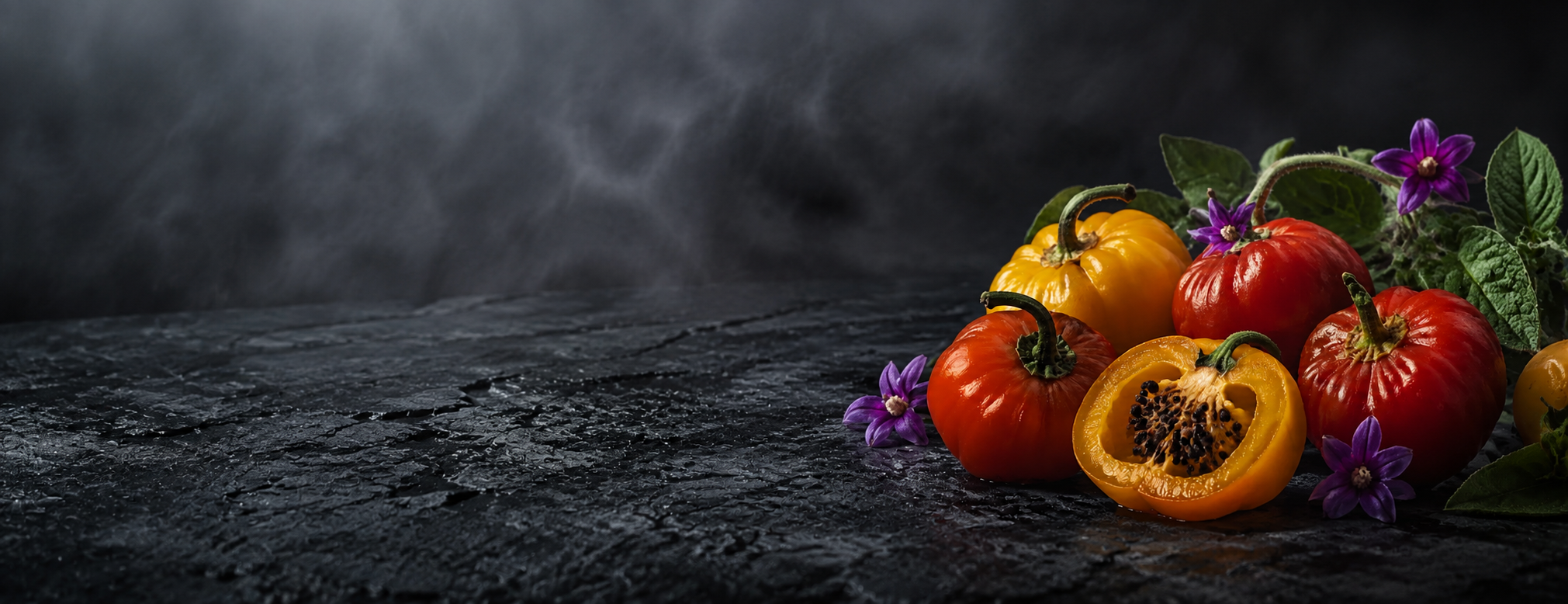
Known as Manzano in Mexico, Rocoto in Peru and Locoto in Bolivia, Capsicum pubescens is a sensory contradiction waiting to be explored. Its apple-like shape conceals an unexpectedly complex flavour architecture: thick juicy flesh, distinctive black seeds, cucumber-green aldehydes, bell-pepper pyrazines, subtle citrus and fruit nuances, and a clean heat wave that can continue building after the initial bite.
This is not a conventional trend report—it is an interactive flavour laboratory and digital artwork. Visitors can dismantle common myths, explore volatile compounds, examine the pepper’s anatomy, reshape its heat curve, travel through its commercial evolution, construct pairing constellations, generate product concepts and record a live sensory trace. Scientific evidence and formulation logic are brought to life through original imagery, responsive graphics, movement and playful experimentation, transforming Manzano from something to simply read about into something to actively discover.

 FlavourTrends • Interactive R&D Intelligence
Evidence updated August 2026
MANZANORocoto • Locoto • Capsicum pubescens
Not an apple-flavoured chile. Its real fingerprint is stranger and more useful: cucumber-green aldehydes, bell-pepper pyrazines, thick juicy flesh and a clean heat wave that often peaks after the bite is gone.
01 • Why now
A real 2026 signal—still pre-mainstream.
Manzano has crossed three important thresholds at once: flavour-industry activation, measurable North American supply and retail translation. That is more meaningful than social noise—but it is not proof of broad consumer familiarity.
IFT FIRST • July 2026
LaunchWixon debuted Manzano Pepper flavour in snacks and beverages, framing it as “Fiery Frontiers”: regional heat with a bright, familiar bridge.
Wixon release ↗Conditional trial signal
>40%Datassential data cited by Wixon says more than 40% of consumers who had tried its three featured flavours loved or liked them. Useful—but not Manzano-only awareness.
Context ↗Mexico → United States
2,870 tSENASICA data cited in 2025 reports exports from Veracruz, Michoacán and Estado de México in 2024: a concrete supply bridge, not a hypothetical one.
Reynolito paper ↗US retail translation
500→2,250Tari expanded its overall US footprint in one year and placed Rocoto in a creamy sauce line. The store count is brand-level—not attributable to the Rocoto SKU alone.
Fancy Food 2025 ↗Supply engineering
110 / 120Tonnes per hectare per year reported as greenhouse potential for new Mayito and Reynolito varieties—far above typical 7–8 t/ha open-field estimates.
Mayito ↗ Reynolito ↗Exports, new cultivars, a current flavour-house launch, active US/Canadian foodservice and a growing Peruvian sauce platform.
No clean public Manzano-only menu penetration series, household awareness number or multi-year North American launch count.
Calling it “the next jalapeño,” treating supplier forecasts as sales data, or claiming apple as the species’ scientifically dominant aroma.
02 • One species, three cultural lenses
Names change. The botanical core does not.
Capsicum pubescens is native from Peru to Bolivia, sits in its own genetically distinct Pubescens lineage and is now culturally embedded from Andean picanterías to Mexican mountain farms.

Apple-shaped chile becomes Manzano.
Mexico received the species long after Andean domestication. Cool central highlands proved suitable, and the rounded fruit inspired the name chile manzano. Yellow fruit is particularly valued in the national and export market.
Genomic correction: recent work places the likely origin in central-western Bolivian highlands and finds the highest genetic diversity there. Kew’s accepted native range remains Peru to Bolivia.
03 • Myth lab
Four shortcuts that will ruin the flavour brief.
Click a claim. The point is not trivia: each misconception pushes product development toward the wrong target, the wrong raw material or the wrong heat system.
Apple is the bridge—not the fingerprint.
Mexican “Manzano” refers to the fruit’s apple-like shape. A 2011 species-specific GC–MS/olfactometry study found the aroma driven mainly by substituted methoxypyrazines and cucumber-like lipid-oxidation aldehydes. Apple, citrus and fruit are valid commercial translations, but they should sit above the green-cucumber core rather than replace it.
Open evidence ↗04 • Aroma fingerprint
Build the pepper you actually mean.
The literature and the 2026 supplier story are not contradictory; they describe different layers. Fresh species identity is cucumber–green–earthy. Product translation can add crisp apple, citrus and fruity sweetness.
A very high-impact cucumber/green aldehyde. Along with 2-nonenals, it separates Rocoto from the ester-heavy tropical character associated with C. chinense peppers.
Processing lens
Switch states to see how the target architecture should move. Scores are evidence-guided sensory direction—not measured concentrations.
Lead with cucumber aldehydes and green/bell-pepper pyrazines; keep fruit esters restrained. Add only enough citrus lift to prevent the profile reading muddy or vegetal.
Scientific anchor: the 2011 study detected more than 200 volatiles across the tested Andean peppers and comparator, with Rocoto aroma primarily attributed to substituted 2-methoxypyrazines and lipoxygenase-cleavage products.
05 • Anatomy lab
The black seed is the clue—not the furnace.
Click the fruit anatomy. Capsaicin is concentrated around placental tissue and can spread onto adjacent inner wall and seed surfaces. Removing the seeds alone is not a reliable heat-control method.
Directional capsaicin risk
Pericarp • thick, juicy delivery system
Manzano’s unusually fleshy wall gives a crisp, wet bite and carries green aroma efficiently. Inner surfaces can acquire capsaicin from adjacent placental tissue, so pericarp-only samples are lower-risk—not automatically mild.
Separate pericarp and placenta during raw-material evaluation. “Deseeded” is not the same as standardized capsaicinoid load.
06 • Time–intensity lab
Design the burn—not just the SHU.
A 2024 trained-panel study found sauce heat often peaked about 20 seconds after expectoration; liquid sauces read hotter than paste types, while 4, 25 and 60°C serving temperatures had minimal effect.
Heat-shape controls
This is a directional sensory model built from published behaviours—not a conversion between slider position and ppm capsaicin.
Bright liquid delivery: clear onset, assertive post-swallow rise and enough acid to sharpen the experience. Keep the first sip below target because the peak arrives late.
07 • Commercial trajectory
From Andean cultigen to 2026 flavour signal.
Drag through the evidence. The story is not a sudden viral breakout; it is a long cultural base, a Mexican supply build and then a sequence of credible North American translations.
Deep Andean cultivation
Historical and genomic work places long cultivation in the Central Andes. The species is known only as a cultigen, with recent genomic evidence pointing toward central-western Bolivia as the likely centre of origin.
Signal: authentic, region-specific cultural depth—not a newly invented pepper story.
Open source ↗08 • Application explorer
Where Manzano earns its name—and where it disappears.
Eight applications are scored directionally for strategic fit, consumer bridge, differentiation and technical risk. The numbers are an expert prioritization tool, not syndicated market measurements.

Fermented Rocoto sauce
Fermentation converts an unfamiliar fresh chile into a familiar delivery system while retaining a distinctive green, juicy core. Current US products show both chef-grade and creamy Peruvian routes.
Watch-out: Lactic acid, garlic and passionfruit can overwhelm the fragile cucumber-aldehyde signature. Define whether authenticity means fresh Manzano or a fermented Rocoto sauce.
Proof: Fresh Pepper markets a current Rocoto-forward fermented cooking sauce; Tari has active US Rocoto extensions.
Open example ↗09 • Pairing constellation
Choose three notes. Make one coherent chord.
Select up to three partners. A useful Manzano pairing should do at least one of three jobs: bridge recognition, clarify the green core or shape the heat tail.
Build the chord
The first selection anchors recognition; the second creates body; the third sets the finish.
Green apple, pineapple or lime makes the first encounter legible. Cucumber or tomatillo exposes the true species identity.
0 of 3 selected10 • Concept studio
800 concept directions—without random flavour soup.
Choose a format, a familiar bridge, an edge and a heat shape. The generator writes a compact development brief and recalculates the target sensory architecture.
Chef-grade condiment
Green Apple–Manzano Ferment
Finished with huacatay; quick, clean heat.
Green apple makes the apple-shaped chile instantly legible, while huacatay restores Andean herbaceousness. Fermentation supplies body and acidity; a quick heat spark keeps the cucumber-green top note visible.
Watch-out: Do not turn this into generic apple-jalapeño. Keep pyrazine and cucumber aldehydes detectable behind the bridge.
11 • Guided sensory run
Turn tasting into a repeatable 120-second experiment.
Select a sample, start the live trace and move both sliders as perception changes. The graph now records automatically; use Pin observation only when you want to mark a critical sensory moment.
Cut the sample, wait 10 seconds, then assess cucumber, green pepper, citrus, fruit and earthiness before capsaicin dominates attention.