
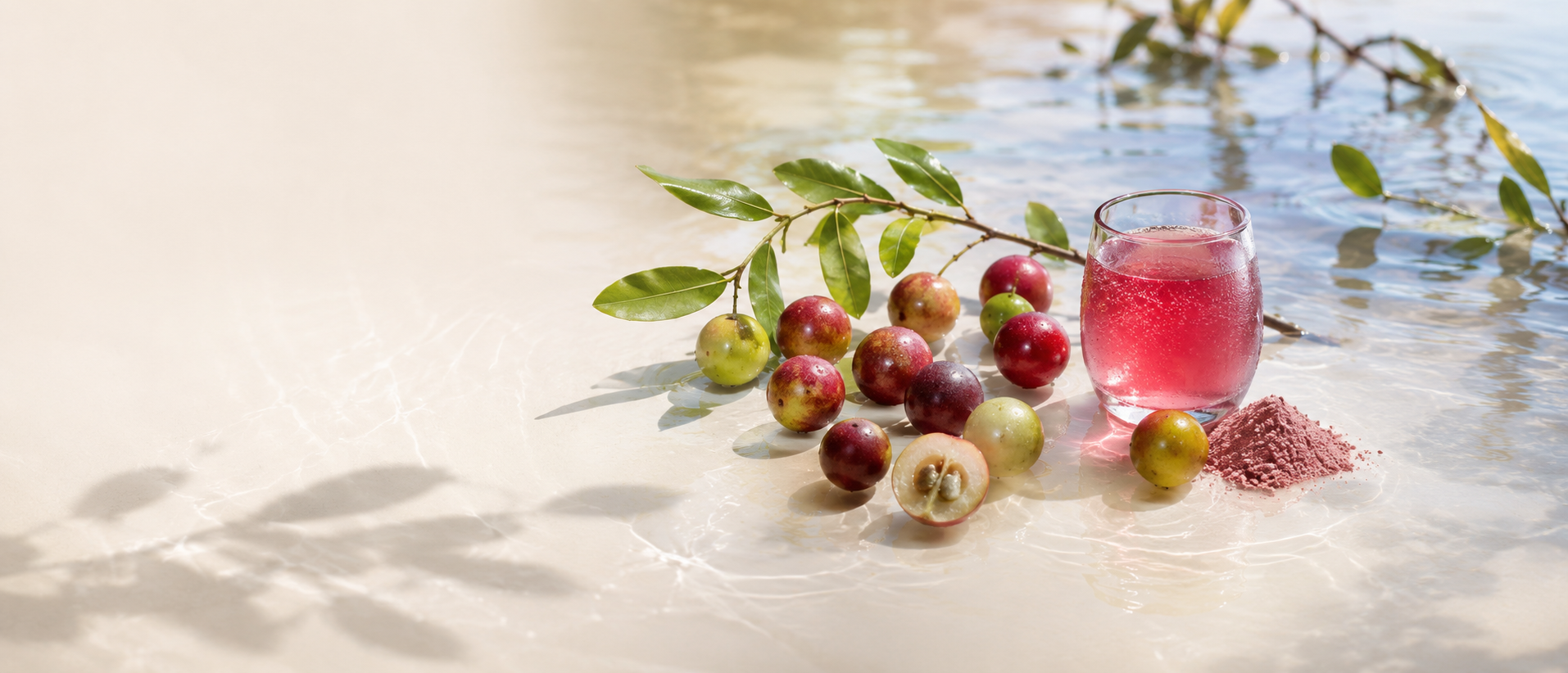
Camu Camu is moving beyond its established reputation as an Amazonian vitamin C source and emerging as a distinctive flavour platform in its own right. The small red-purple fruit combines an exceptionally sharp citric attack with malic length, restrained natural sweetness, peel-derived bitterness and astringency, and a surprisingly precise aroma structure spanning fruity ester, citrus peel, green pine and woody spice. That tension makes Camu Camu more than another sour berry: it can bring vivid refreshment and botanical complexity to sparkling drinks, functional shots, frozen desserts, confectionery, culinary sauces and adult beverages.
This interactive Flavour Pulse turns that chemistry into a scientific and artistic playground. Readers can move through ripeness, rebuild the fruit’s acid balance, explore experimentally confirmed aroma molecules, compare it with acerola, cranberry and calamansi, test processing routes, create pairing constellations and generate more than 1,000 product concepts. Animated statistics, responsive visuals and live sensory tools make the research playful while showing how provenance, maturity, processing, sweetness and product matrix determine whether Camu Camu tastes vivid and authentic—or simply harsh.
Myrciaria dubia • Amazonian acid architecture
CAMU CAMUFLAVOUR PULSE
A cherry-sized Amazonian fruit with extreme sourness, restrained sweetness and a surprisingly precise aromatic quartet: fruity ester, citrus peel, green pine and woody spice.
01 • Signal pulse
From supplement ingredient to visible flavour platform.
Camu Camu has existed quietly in powders and functional blends for years. The stronger signal is its 2025 translation into named foodservice purée, dedicated health shots and ready-to-drink formats where the fruit itself becomes part of the consumer story.
North America • 2025
PURÉEThe Perfect Purée launched Camu Camu for U.S. and Canadian foodservice, translating a specialist ingredient into a chef- and bartender-ready format.
UK functional beverage
2Rebel Kitchen introduced 60 mL shots and 420 mL dosing bottles, making Camu Camu the named hero rather than a back-label nutrient source.
RTD translation
RTDTupan paired Camu Camu with an upcycled roasted-açaí brew, showing a more complex adult route beyond sweet tropical juice.
Sensory proof
4Isoamyl acetate, α-pinene, limonene and β-caryophyllene exceeded odour thresholds and rebuilt the fruit’s fruity, herbal, citrus and woody aroma.
Opportunity read
A high-impact acid modifier with a provenance story.
Camu Camu is best treated as a sharply differentiated sour-fruit platform—not a substitute for lemon. The most credible concepts allow the fruit’s woody-green Amazonian signature to remain detectable while using familiar fruits, sweetness and texture to manage intensity.
02 • Fruit + floodplain
Ripeness rewrites colour, sugar and acid perception.
Camu Camu grows naturally along seasonally flooded rivers and lakes. The small fruit changes from green through mottled red to red-purple; sugars, soluble solids and several chemical fractions rise with maturity, while peel anthocyanins intensify the visual signal.

03 • Acid tension lab
The flavour lives in imbalance.
Camu Camu is not simply “very sour.” Citric acid supplies the main attack, malic acid stretches the finish, ascorbic acid reinforces sharpness, and peel extraction adds bitterness and astringency. Sugar decides whether the system feels electric or punishing.
Directional sensory model—not a formulation calculator. Validate with the actual juice, sweetener, buffer and process.
04 • Aroma orbit
Four molecules make the fruit recognisable.
A 2023 sensomics study found four compounds above their odour thresholds and verified their contribution by aroma recombination. Supporting GC-MS work reveals a broader Myrtaceae terpene background, but abundance alone does not prove sensory impact.
CC(C)CCOC(=O)CActive molecule
The fruit-readable top note.
Isoamyl acetate provides the most immediately familiar fruity cue in Camu Camu. Against the fruit’s severe acidity, even a controlled ester signal helps the brain interpret the system as berry-like rather than simply sour.
05 • Organoleptic comparator
Camu Camu is not acerola, cranberry or calamansi.
All four can occupy a bright, high-acid space, but their flavour architectures differ. Use the comparator to see why Camu Camu needs more than generic berry, citrus or vitamin-C cues.
Directional sensory lens
Camu Camu vs acerola
What changes in the mouth
More bracing, lean and peel-driven, with citrus, pine, woody spice and an extended acid/astringent finish.
Also high-acid and vitamin-C-associated, but generally rounder, red-fruit-forward and less resinous or woody.
06 • Processing survival lab
Every format protects something—and sacrifices something.
Frozen purée best preserves a direct sensory reference. Freeze-drying improves portability. Spray drying can protect selected bioactives, but carrier choice matters: published work found different advantages for gum arabic, maltodextrin and whey protein, with humidity remaining a major storage risk.
The comparative scores are directional. Published findings are identified explicitly in each state.
07 • Application engine
Do not hide the tension—design around it.
Camu Camu works best when the format gives its acidity a purpose: refreshment, intensity, contrast or culinary lift. Very sweet systems can make it generic; very lean systems can become punishing.

Best flavour-forward route
Camu Camu sparkling refresher
Carbonation makes the sharp attack feel intentional, while a red-fruit or tropical bridge supplies body. Keep enough pine, citrus peel and woody spice to prevent the product from becoming anonymous pink lemonade.
Commercial proof: current RTD and foodservice launches validate refreshment, cocktail and functional routes.
08 • Pairing constellation
Build a chord around the acid.
Select up to three notes. The constellation identifies whether the chord softens Camu Camu, amplifies its Amazonian provenance, brightens the top note or drives it toward an adult culinary profile.
Choose up to three
09 • Concept studio
Turn the tension into a product brief.
Choose one element from each row. The studio generates more than 1,000 concepts while keeping Camu Camu’s acidity, aroma evidence and processing constraints visible.
Generated concept • 1 of 1,050
Mango–Camu Camu Sparkling Cloud
A finely carbonated Camu Camu refresher with mango body, a soft cloud texture and a sea-salt finish. Use a protected citrus-pine top note and restrained red colour; buffer only enough to maintain repeat sipping without erasing the fruit’s defining acid tension.
10 • Sensory calibration
Evaluate more than sourness.
Rate the sample, then move through the temporal phases. The radar separates acid attack, fruit readability, citrus-herbal aroma, bitterness, astringency and finish so the panel can diagnose why a sample feels authentic—or merely harsh.