
Tamarind is shifting from a culturally rooted souring ingredient into a versatile global flavour platform. Its distinctive combination of tartaric sharpness, dark fruit, caramelized pulp and gentle astringency allows it to bridge sweet, savoury and adult-beverage applications with unusual credibility. Momentum across sodas, spicy confectionery, snacks, sauces, spirits and ready-to-drink cocktails suggests the next opportunity lies beyond novelty: carefully calibrated tamarind concepts that retain its authentic sweet-sour tension while translating it into modern, highly differentiated products.


Evidence-led • 2026
A global souring agent becomes a flavour platform
Sweet. Sour. Dark. Alive.
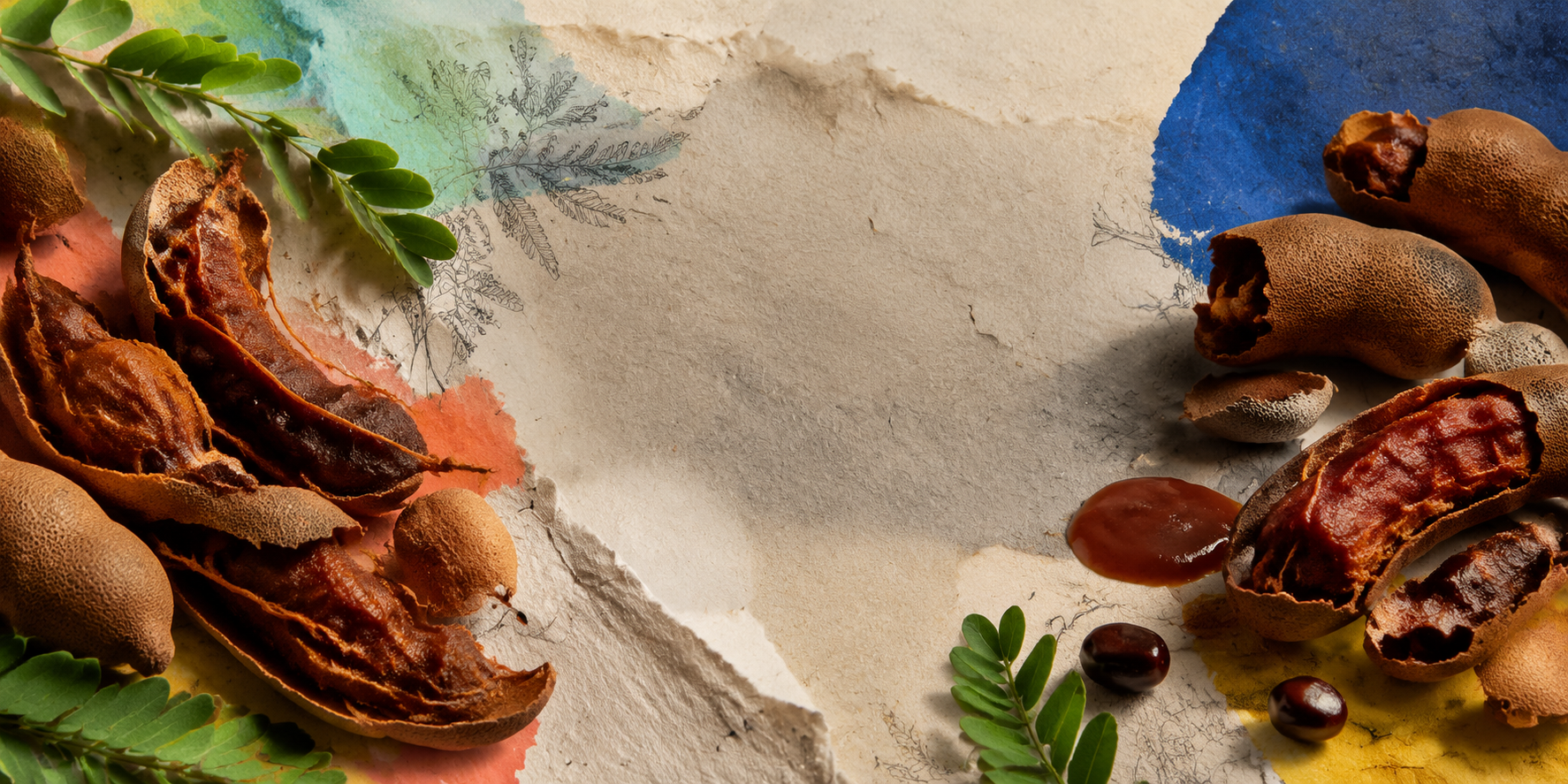
Tamarind is no longer just the hidden acid in chutney, pad thai, Worcestershire sauce or agua fresca. Its unusual bridge of tartaric sharpness, dried-fruit depth and caramelized brown notes is now moving through snacks, spirits, RTDs, sauces, confectionery and modern café systems.
Signal snapshot
Not a new ingredient. A newly visible system.
The shift is not tamarind suddenly appearing; it is tamarind escaping the “ethnic aisle” and becoming a named, marketable flavour across mainstream formats.
Growth in new US menu items featuring tamarind over four years, reported by Wixon using Datassential.
Source ↗#tamarind views plus more than 8,000 TikTok posts tracked across three years.
Source ↗Interest in tamarind among US dips-and-sauces category users in 2024–25 research.
Source ↗Projected US menu growth from 2023 to 2027—steady continuation after the initial spotlight.
Source ↗Why it is moving now
Six forces are converging.
McCormick’s 2024 Flavor of the Year put tamarind inside a broader appetite for sharper, traceable acidity.
Evidence 02 • Swicy with heritageTamarind supplies sweet, sour and fruit depth before chile is added—making heat feel integrated rather than bolted on.
Evidence 03 • Cross-cultural reachAfrica, South Asia, Southeast Asia, the Middle East, Mexico and the Caribbean each offer real use traditions.
Evidence 04 • Culture-coded RTDsVMC, Gran Malo, Smirnoff and Mission Craft show the profile scaling from shots to tequila RTDs and bar-strength cocktails.
Evidence 05 • Sauce white spaceTamarind can make “sweet heat” darker, tangier and more culinary while supporting simple, recognizable ingredient stories.
Evidence 06 • Technical flexibilityRecent beer research found the best acceptance at 20 g/L; more pulp was not automatically better—a useful formulation lesson.
EvidenceInteractive launch journey
AncientTraded long before it was “trending”
Kew records tamarind in eastern Mediterranean cultivation by the fourth century BCE. The sticky acidic pulp travelled widely enough for Arabic traders to name it tamr hindi—“date of India.”
Signal: extraordinary geographic portability preceded modern product portability.
Open source
Global route selector
One pod. Multiple authentic frames.
Click a route to see how tamarind changes role by culinary context. The opportunity is not to flatten these traditions into “exotic”; it is to use them as credible launch architectures.
Origin + refreshment
Acidic fruit, shade tree, cooling drink
Kew places the accepted native range in Comoros and Madagascar; across parts of Africa and the Levant, tamarind also appears in drinks, stews and fermented preparations.
Modern translation: botanical coolers, dark-fruit sparkling drinks and savoury glazes.
SourceTamarind voltage lab
Tune the tension.
Adjust maturity, load, sweetness, heat and processing. The live profile is a directional formulation model—not consumer research—and makes the central risk visible: tamarind can move from vivid to muddy very quickly.
Live controls ready—drag a slider or choose a process.
Application observatory
Where the flavour can win next.
Choose a format. Each view combines a strategic read, formulation role, pairing logic and a clickable market proof point.
Agua fresca → modern soda
Tamarind already has beverage legitimacy. The opportunity is to retain its dark-fruit identity while lightening body, sugar and colour for sparkling and functional refreshment.
Scores are an editorial directional model, not measured consumer data.
Pairing switchboard
Build a tamarind flavour chord.
Select up to three partners. The live core maps each note as it joins the chord—and flags when tamarind risks being buried.
Mango, lime or pineapple makes trial easier; a second note can add heat, roast or adult complexity.
0 of 3 selected100-combination concept studio
Turn evidence into a brief.
The generator produces strategic starting points, not finished formulas. Validate identity, acid balance, stability and cultural framing through real development work.
Low-sugar refreshment
Mango–Tamarind Sparkling
Finished with chile.
Mango supplies recognition and plush fruit; carbonation lifts tamarind’s acid; chile lengthens the finish without requiring more sugar.
Watch-out: Keep the liquid translucent and the tamarind note distinct from generic mango-chile.
Evidence position: beverage legitimacy + sweet-heat familiarity.
Open evidence ledger
Every major claim is clickable.
Commercial signals are separated from scientific composition and from directional interpretation. Dates and claims were checked in August 2026.
20 sourcesOpen the complete evidence ledger
01Kew • origin, ancient trade and global useBotany
Kew describes tamarind’s accepted range, thousands of years of use, eastern Mediterranean cultivation by the fourth century BCE and the Arabic naming route.
Open Kew02McCormick FONA • 122M views, 8K posts, +10% menu forecastTrend
McCormick’s 2024 spotlight gives the clearest compact social and menu forecast signal.
Open source03Wixon / Datassential • +202% new menu-item growthTrend
Wixon’s 2025 IFT FIRST launch cites 202% growth in new US tamarind menu items over four years and positions the flavour for sweet, tangy and spicy systems.
Open source04Advantage Solutions • 46% Latinx shopper interestConsumer
Summer 2024 shopper work reports 46% interest in tamarind among Latinx shoppers and highlights sampling as a trial driver.
Open source05Imbibe • 49% sauce-user interestConsumer
US category research reports interest among 49% of dips-and-sauces users—useful evidence for moving beyond beverages and candy.
Open source06McCormick + Black Tap • 2024 LTO activationMenu
McCormick translated the Flavor of the Year into limited-time tamarind menu items across US and select global Black Tap locations.
Open source07Doritos Tangy Tamarind • 2022 national salty-snack LTOLaunch
The launch was billed as the first tamarind flavour from a major US salty-snack brand.
Open source08Smirnoff Spicy Tamarind • US scale + R&D intentLaunch
US expansion reached more than 15 new markets in 2020; Diageo later described the differentiation and nostalgia strategy behind the product.
US expansion • R&D story09Gran Malo • 2025 US expansionLaunch
Spirit of Gallo said Gran Malo became Southern California’s biggest new spirit brand of 2024 before expanding across six US states in 2025.
Open source10VMC Tamarindo • tequila RTD launch, 2025Launch
VMC framed its tamarindo tequila cocktail around agua fresca and Mexican candy cues, adding the flavour to Margarita, Paloma and Jamaica.
Open source11Mission Craft Tamarind Margarita • nationwide RTD, 2026Launch
The bar-strength cocktail combines tequila, orange liqueur, lime, tamarind, agave, watermelon and chile and lists leading US retail distribution.
Open source12Mezcal Trascendente Tamarindo • US launch, 2025Launch
The flavoured mezcal entered more than 15 US markets with dried-fruit, soft-citrus and cooked-agave framing.
Open source13Jarritos × Canel’s candy • 2025Launch
Tamarind appeared across classic and sour gummies and spicy lollipops—an example of beverage flavour equity moving into confectionery.
Open source14Tamarind Heads • retail expansion, 2025Launch
The six-ingredient tamarind-led BBQ sauce expanded into all Fairway Market locations after winning a sofi Gold Award.
Open source15Morimoto × Williams Sonoma • tamarind in ramen broth, 2025Launch
A premium Tan Tan Ramen Broth Concentrate combines coconut, Thai chile, tamarind, fish sauce and red curry.
Open source16Tamarind chemistry • acid, sugar and pectin rangesScience
Peer-reviewed work reports 8–18% tartaric acid, 25–45% reducing sugars and 2–3.5% pectin, with ripening and storage changing colour and composition.
Open paper1796-genotype organic-acid study • 2024Science
HPLC profiling demonstrates significant acid variation across 96 tamarind genotypes—a warning against assuming one universal raw-material profile.
Open paper18Craft beer dosage study • 2026Science
Beer with 20 g/L tamarind pulp achieved the best overall acceptance; 40 and 60 g/L increased acidity and bitterness without improving acceptance.
Open paper19Tamarind quality correlations • 2025Science
A genotype study found strong links between soluble solids and sugars and a negative relationship between tartaric acid and total sugar.
Open paper20Indian production • FY2025Supply
Statista reports about 138,000 tonnes of Indian tamarind production in FY2025, led by Tamil Nadu at roughly 42,000 tonnes.
Open source